
AI-Powered Financial Planning? Inside NetSuite’s SuiteAnalytics and Predictive Tools
By Dowyn Kate for Foresee Solutions Published
Financial planning has traditionally been a backward-looking exercise: close the books, analyze what happened, then plan for what’s next based on historical patterns and manual spreadsheet modeling. AI-powered analytics tools are changing that sequence giving finance teams forward-looking insight embedded directly into their ERP.
For finance leaders across the GCC managing multi-entity operations, multi-currency reporting, and increasingly complex compliance requirements, this shift matters. This guide looks at what NetSuite’s SuiteAnalytics and predictive tools actually do, and how finance teams are putting them to use.
The Shift from Reactive to Predictive Finance
Traditional financial planning cycles typically follow a pattern: data is collected and reconciled after the fact, reports are generated to explain what already happened, and forecasts are built manually, often in spreadsheets, based on historical trends and a fair amount of judgment.
This approach isn’t wrong, but it’s slow, and it puts finance teams in a permanently reactive position, explaining the past rather than shaping the future. Embedded AI and analytics tools shift some of that work earlier in the cycle: instead of only reporting on what happened, the system can help identify patterns and generate forward-looking projections as part of the same platform where the underlying data already lives.
What SuiteAnalytics Does
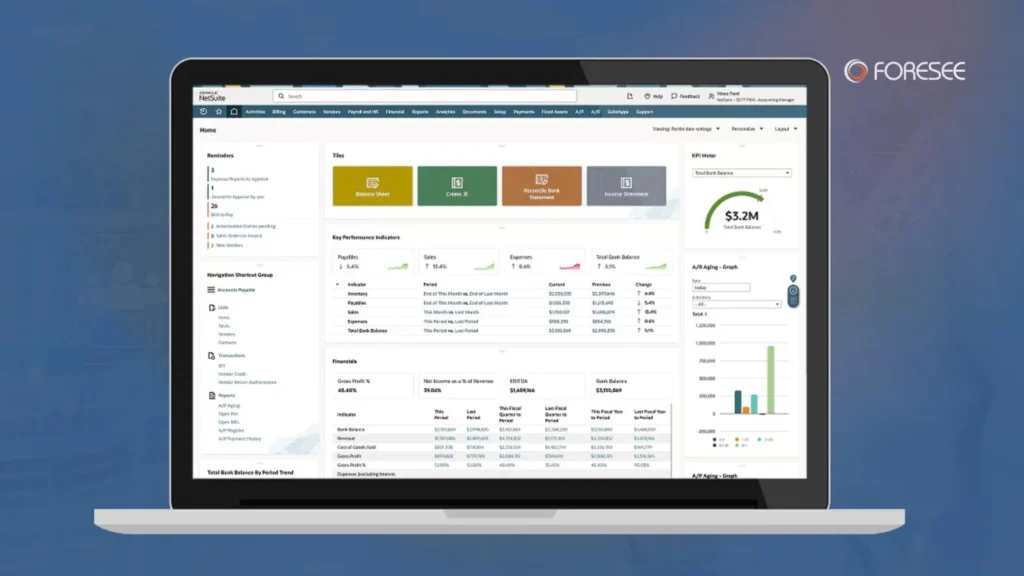
SuiteAnalytics is NetSuite’s embedded reporting and business intelligence layer, built directly into the platform. Because it sits on top of live operational data, reports and dashboards reflect current activity rather than a periodic export.
Core capabilities include:
Real-time dashboards and KPIs. Finance and operational leaders can view live dashboards reflecting current financial position, rather than waiting for periodic manual report generation.
Ad hoc reporting and analysis. Users can build custom reports and drill into underlying transaction-level data without needing separate technical tools or IT support for every new reporting need.
Cross-functional visibility. Because SuiteAnalytics draws on the same unified data across finance, inventory, and sales, it supports reporting that spans departments rather than requiring manual consolidation of data from separate systems.
Increasingly predictive elements. Beyond historical and real-time reporting, NetSuite has continued incorporating forward-looking and pattern-based analytical capabilities, aimed at supporting forecasting rather than only historical analysis.
Predictive Forecasting & Scenario Planning in NetSuite
Predictive capabilities within NetSuite aim to support finance teams in a few key planning areas:
Cash flow forecasting. By analyzing historical payment patterns, outstanding receivables and payables, and transaction trends, predictive tools can generate more accurate cash flow projections than static spreadsheet-based models, which matters significantly for businesses managing working capital across multiple entities or currencies.
Demand and revenue forecasting. For businesses with sales and inventory data flowing through the same platform, predictive tools can support more accurate demand and revenue projections, incorporating seasonality and historical patterns rather than relying purely on manual estimation.
Scenario and variance analysis. Finance teams can model different scenarios and compare actual performance against plan more efficiently when the underlying data and forecasting tools live in the same system, reducing the manual work of reconciling separate planning spreadsheets against actuals.
It’s worth noting that the depth of predictive capability continues to evolve, and businesses should have realistic expectations: these tools are strongest when built on clean, sufficient historical data, and they support human judgment.
Real-World Applications for GCC Finance Teams
Multi-currency, multi-entity consolidation. For groups operating across the UAE, Saudi Arabia, and other GCC markets, embedded analytics that consolidate multi-currency, multi-entity data in real time reduce the manual reconciliation burden that typically accompanies month-end close for regional groups.
Faster response to compliance-driven reporting needs. As VAT and ZATCA e-invoicing requirements continue to evolve, having real-time, accurate underlying data supports faster, more confident compliance reporting compared to reconciling separate systems under time pressure.
Better working capital management. More accurate cash flow forecasting directly supports decisions around receivables management, payment timing, and short-term financing needs.
Faster leadership decision-making. Real-time dashboards mean leadership isn’t waiting for month-end reports to understand current performance, supporting faster strategic decisions in fast-moving regional markets.
Getting Started: Implementation Considerations
Data quality is the foundation. Predictive and analytical tools are only as reliable as the underlying data. Businesses considering these tools should prioritize clean, consistent data entry practices and address historical data quality issues during implementation.
Start with core reporting needs before advanced predictive features. Businesses new to embedded analytics often benefit from establishing strong real-time reporting and dashboard practices first, then layering in more advanced predictive and scenario planning capabilities as the team builds familiarity with the platform.
Involve finance leadership early in configuration. Dashboards and reports are most useful when built around the specific KPIs and questions finance leadership actually cares about, rather than generic default templates.
Train the team on interpreting, not just generating, insights. The value of predictive tools comes from how the team acts on the insights generated not just report generation.
Frequently Asked Questions
Is SuiteAnalytics included in standard NetSuite licensing, or is it an add-on?
This depends on the specific NetSuite edition and modules licensed. It’s worth confirming exact inclusion during the sales or scoping process.
How accurate are NetSuite’s predictive forecasting tools?
Accuracy depends heavily on the quality and depth of historical data available. Businesses with clean, sufficient transaction history generally see more reliable forecasting than those with limited or inconsistent historical data.
Can SuiteAnalytics replace a dedicated business intelligence tool?
For many mid-size businesses, SuiteAnalytics provides sufficient reporting and analytics depth without needing a separate BI tool. Larger enterprises with more complex analytical needs sometimes still integrate specialized BI platforms alongside NetSuite.
Do I need a data analyst to use SuiteAnalytics effectively?
Not necessarily for standard reporting and dashboards, which are designed for business users. More advanced custom analysis or predictive model configuration may benefit from either an internal analyst or implementation partner support.
How long does it take to see value from embedded AI/analytics features after implementation?
This varies, but businesses often see immediate value from real-time dashboards and reporting, while predictive forecasting accuracy typically improves over time as the system accumulates more historical data to learn from.
Related services and guides

AI & Automation

Data & Dashboard